


The latest news from the autonomous driving test field.
Please note: Most of these texts are only available in German.
Focus on Cross-Border Autonomous Driving
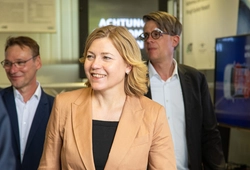
High-ranking guest at the FZI: Henna Virkkunen — Vice-President for Tech Sovereignty, Security and Democracy, and Commissioner for Digital and Frontier Technologies — met with Baden-Württemberg’s Minister of Transport Winfried Hermann to learn more about the Test Area Autonomous Driving Baden-Württemberg. Digital sovereignty, technological independence, security, and democracy fall within the remit of her commission — topics that are the focus of research at the FZI.
TAF BW as a Key to Future Mobility
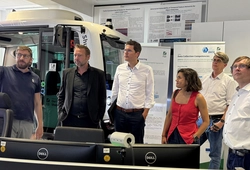
On Monday, June 23, 2025, Jan Wiesenberger, Executive Director of the FZI, welcomed two members of the Baden-Württemberg Ministry of Transport for an intensive exchange: Philipp Franke, Head of Department 5: Mobility Center, Networked and Digital Mobility, and Peter Baier, Head of Department 54, which is responsible for intelligent roads and automated driving. The focus was on the Test Area Autonomous Driving Baden-Württemberg (TAF BW) as a real-world laboratory for mobility concepts in both urban and rural areas.
Matthias Gastel Visits the FZI in Karlsruhe
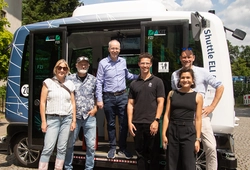
How can autonomous vehicles make public transport in urban and rural areas more sustainable, flexible, and safe? Matthias Gastel, Member of the German Bundestag (Bündnis 90/Die Grünen), explored this question during a visit to the FZI Research Center for Information Technology in Karlsruhe. His visit focused on research into autonomous minibuses and their potential application in local public transport (ÖPNV).
Mobility Research in European Dialogue
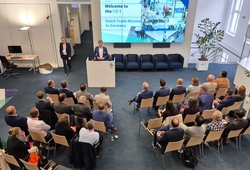
On May 22, 2025, the FZI Research Center for Information Technology welcomed a high-ranking delegation from the Netherlands. The visit focused on international cooperation opportunities, technological developments in the field of automated mobility, and demonstrators of current research in the FZI House of Living Labs.
Project C2CBridge2 launched
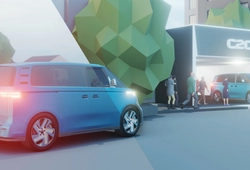
Commuting from the countryside to the city is often tedious. Especially in rural areas, public transport does not offer an alternative to the private car. This is where the Country to City Bridge 2 (C2CBridge2) research project comes in. The aim is to create a reliable, efficient, sustainable mobility service linking rural and urban areas.
A particular focus is on new automated vehicle concepts. These include shared, autonomous, on-demand taxis that are flexible, safe, and accommodate different lifestyles, such as people with prams, wheelchairs, or luggage. At the same time, mobility hubs will be explored to enable convenient transfers to and from other modes of transport. Researchers are also evaluating both technical solutions and social acceptance.